
The $25 Loophole Sending Wild Mustangs to Slaughter
A legal loophole lets the government sell protected mustangs for as little as $25. Coverage splits between an NYT investigation, BLM's flat denial, and advocates' data.
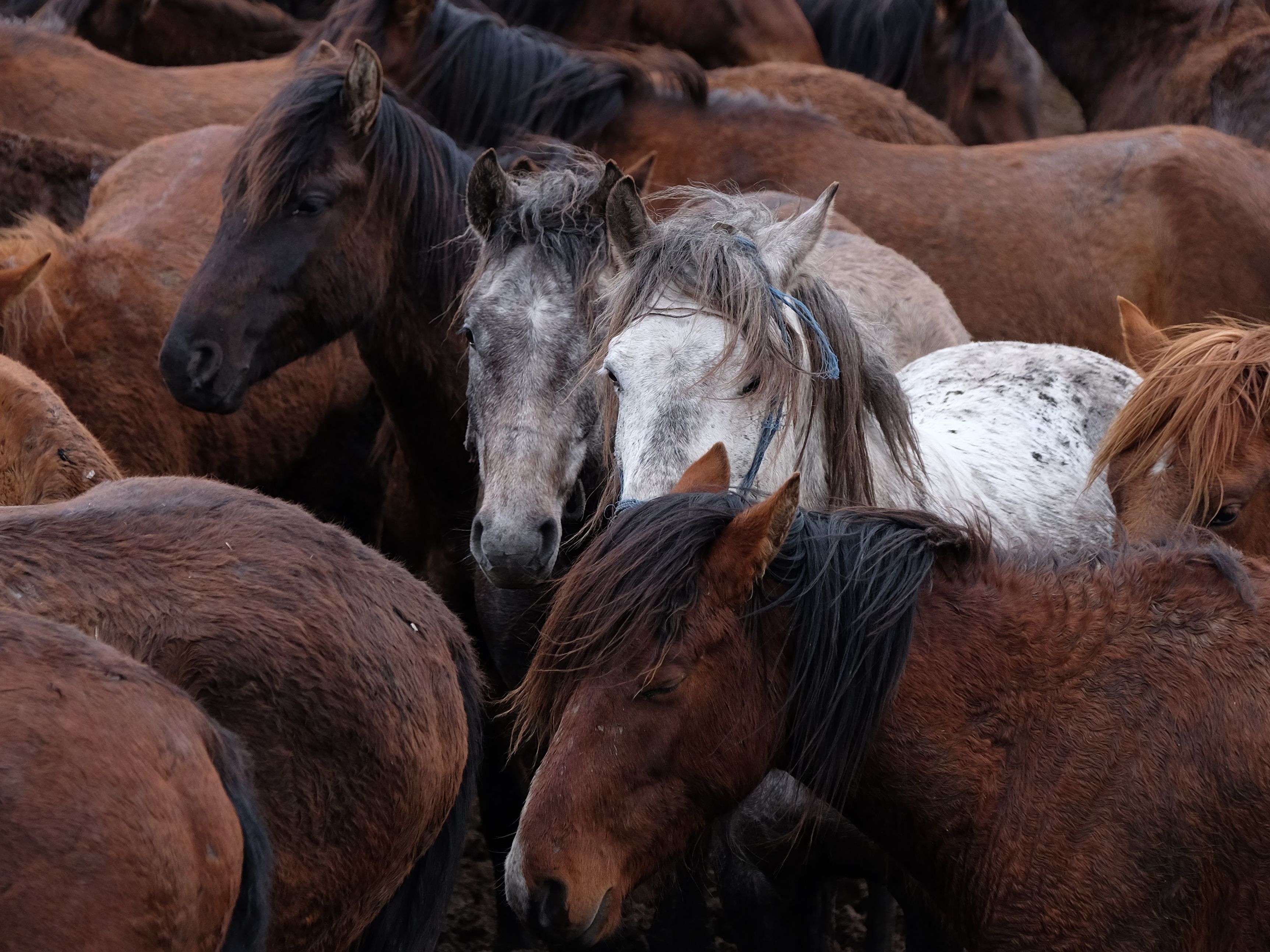
Sixty-eight wild mustangs once ran free in the desert mountains of the West. The government rounded them up by helicopter, held them for years in an Idaho feedlot, and this past March finally found them a "home." That home was the pens of an Ohio livestock trader named Brandon Jones, who bought the whole band for $25 a horse. A day later, two double-decker cattle trucks pulled up at midnight, loaded the mustangs, and drove off. Nobody outside that transaction knows for certain where they ended up.
That scene, reported by The New York Times on August 20, is the anchor for a story that's since split into competing versions depending on who's telling it: an investigative newsroom, a federal agency, an advocacy sanctuary with a spreadsheet, and a Wyoming rancher who thinks the whole thing is overblown.
How the Loophole Actually Works
Killing a wild horse is illegal. Congress has barred the Bureau of Land Management from spending money to do it, and public opinion has kept that ban in place for decades. But the bureau still has to manage roughly 73,000 mustangs on federal rangeland, and it can't legally kill the excess. So it built a release valve instead — one that doesn't technically violate the law, even if it produces the outcome the law was written to prevent.
A captured horse first has to be shown to be unadoptable, which the bureau does by posting it online for three one-week listing cycles. If nobody bites, the horse can be sold instead of adopted. That distinction matters enormously: an adopted horse keeps its federal protections for life. A sold one loses them immediately. The buyer signs a contract promising not to slaughter the horse or knowingly resell it to someone who will — but once it passes to a middleman who never signed anything, the trail goes legally cold.
The bureau spends more than $3,000 capturing and processing each mustang, then sells it for as little as $25. A horse can fetch up to $750 at a Canadian slaughter plant, since the U.S. hasn't had domestic slaughterhouses since 2007. That gap is the entire business model.
The Numbers Advocates Are Pointing To
Much of the Times' reporting draws on a year-long investigation by Skydog Sanctuary, an Oregon-based wild horse nonprofit that has been combing BLM sales records since October 2024. Its findings, published alongside the Times piece:
- The bureau sold 6,331 wild horses in 19 months — roughly five times its historic annual average of 1,200.
- More than 72% of those horses (4,597 animals) sold for $25 or less, the program's price floor.
- Jones alone acquired about 496 horses in a single year, with the bureau covering shipping costs, despite having no prior ties to the wild horse world and being approved just weeks after a federal court shut down a separate adoption-incentive program that had been the agency's main outlet for excess horses.
- Skydog says it has tracked 333 government-branded horses turning up in kill pens this year alone.
The bureau disputes none of the raw sales numbers but rejects the slaughter framing. Skydog has filed eight formal complaints; the Interior Department's inspector general referred the group back to the BLM rather than opening its own inquiry.
Three Tellings, One Set of Facts
The Times frames this as a story about bureaucratic maneuvering — an agency technically complying with the letter of a law while defeating its purpose. Dave Philipps' reporting leans on paper trails: livestock inspection records, brand numbers, an application file that should have raised flags and didn't.
The BLM's public position, given to both the Times and Cowboy State Daily, is a flat denial: "The Bureau of Land Management does not sell or send wild horses or burros to slaughter." The agency says any violations get referred to law enforcement, and that people who abuse the program shouldn't be confused with "the thousands of responsible Americans" who adopt or buy mustangs legitimately. Notably, the bureau declined to make any official available for an interview and didn't answer questions about Jones' specific application.
A third, less-covered voice complicates both narratives. Greg Sheehan, a former U.S. Fish and Wildlife Service director now leading the Mule Deer Foundation, told Cowboy State Daily that leakage into slaughter channels happens but isn't systemic: "Are there a few cases? Yes, there are, but it's not systemic." A Fremont County rancher who grazes cattle on land the BLM cleared of mustangs credited the roundup program with saving his operation during a dry year, and pushed back on the idea that the agency acted with intent. That view rarely makes it past regional outlets into the national conversation, even though it comes from people who deal with the program on the ground.
Humane World for Animals adds a policy layer the other coverage mostly skips: the administration's FY26 and FY27 budget requests both proposed eliminating the congressional appropriations rider that bars the BLM from spending money in ways that lead to slaughter. That rider has protected wild horses for decades regardless of which party controlled Congress. If it disappears, the current loophole becomes a moot point — slaughter wouldn't need a workaround anymore.
What the Coverage Leaves Out
Almost none of the reporting dwells on the alternative the bureau has had for 20 years and mostly ignored: dart-delivered fertility control, which the agency's own researchers have repeatedly recommended expanding. Instead, the bureau spends most of its $142 million wild horse budget warehousing 58,000 horses in long-term holding, which leaves little money for the prevention that would shrink the roundup pipeline in the first place. That's not a partisan failure so much as a budget-allocation one — and it's the detail that explains why this keeps happening regardless of who's in the White House.
It's a pattern worth watching alongside other cases where a legal technicality lets an outcome persist that the underlying law was written to stop — the same dynamic that let illegal miners in the Amazon exploit gaps between environmental law and enforcement capacity half a world away.
Sources & Further Reading
- The New York Times: "Under Trump, Protected Wild Horses Are Going to Slaughter" — the original investigation.
- Cowboy State Daily: "Mustang Advocates Say Report Proves Wild Horses From Wyoming Sent To Slaughter" — BLM's denial and a dissenting local view.
- Equus Magazine: "Federal wild horse sales program under fire after investigation confirms slaughter pipeline" — Skydog Sanctuary's underlying data.
- Humane World for Animals: "Hundreds of America's wild horses reportedly sent to slaughter under Trump" — the budget and appropriations-rider angle.
- politics
- environment
- public lands
- wildlife
- government accountability
Related stories

The AI Boom's Electric Bill Just Became a Midterm Weapon
Political reporters are covering the data-center backlash as a 2026 election story. Policy reporters call it a market failure. Both are skipping the part where nobody's fix is tested yet.
Read the story
$4.10 a Gallon: Inside the EPA's Three-Week Gas Price Fix
The EPA's emergency gasoline waiver reads as consumer relief in most coverage. Trade press shows it's also timed to the midterms and a win for ethanol producers.
Read the story
A 0.02% Statistic Became 'I Won the Election'
A Census Bureau report flags 24,000 possible noncitizen voters from 2020 — 0.02% of ballots cast. Trump calls it proof. Reporters found an authorship problem.
Read the story