
AI Is Quietly Rewriting Healthcare in Ghana — And It’s Happening Faster Than You Think
From portable labs to cancer diagnostics, AI is already reshaping healthcare access in Ghana—long before most people realize it.
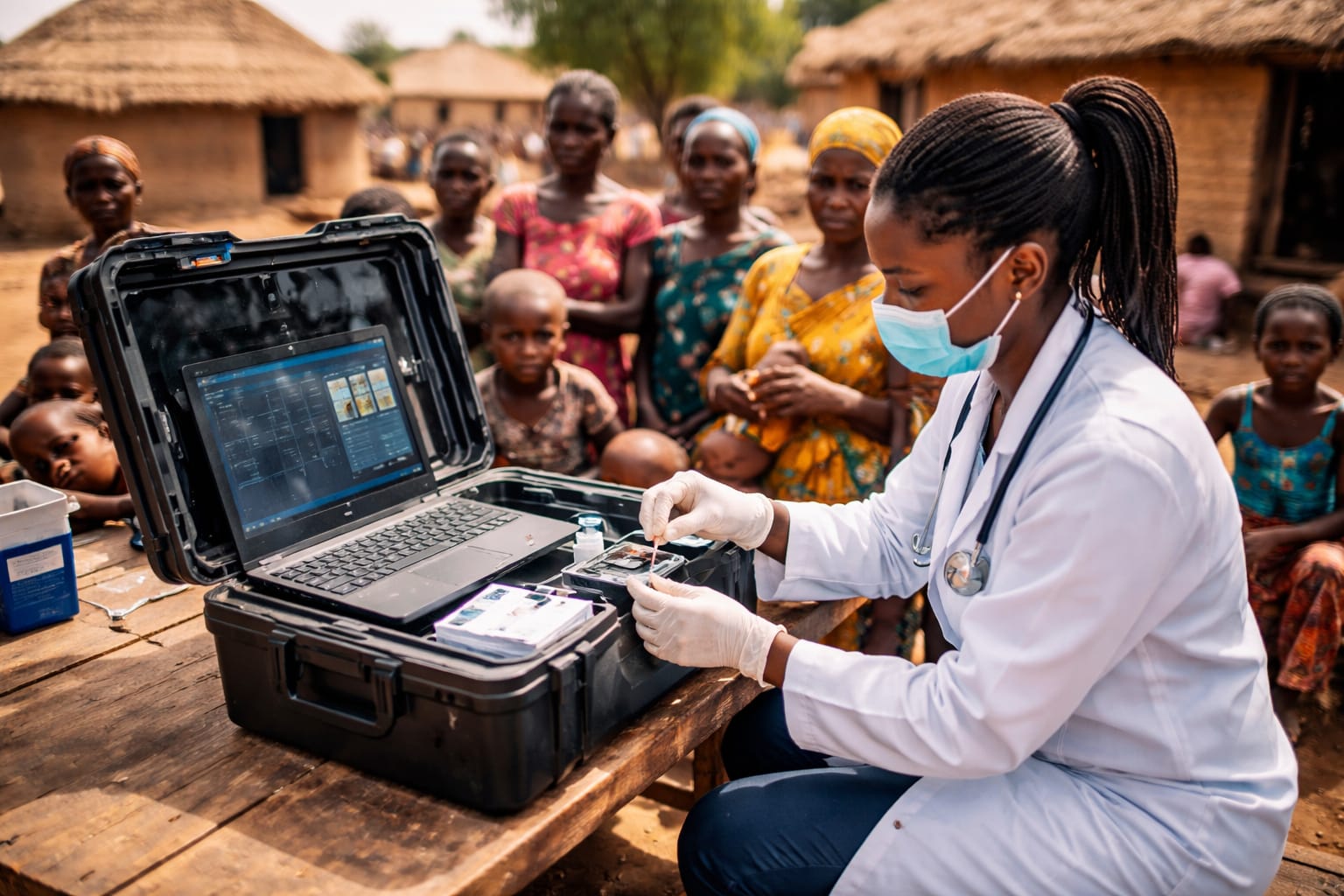
A recent report on an AI-powered “lab-in-a-bag” designed for disease detection in Ghana might sound like another futuristic headline—but it’s not. It’s a signal.
Across Ghana and much of Africa, artificial intelligence is no longer theoretical. It’s being tested, adapted, and deployed in ways that directly address one of the continent’s biggest challenges: access to healthcare.
And what’s emerging isn’t Silicon Valley-style innovation. It’s something far more practical—something built for reality.
The Breakthrough That Fits in a Bag
The “lab-in-a-bag” concept is simple but powerful: a portable diagnostic system enhanced with AI, designed to bring testing capabilities directly to underserved communities. Instead of requiring patients to travel long distances to hospitals—or wait days for results—this kind of tool could enable rapid, on-the-spot diagnosis.
While the technical specifics of the system haven’t been publicly detailed, its purpose is clear: reduce delays, cut down misdiagnosis, and bypass infrastructure gaps that have long limited healthcare delivery in rural areas (GhanaWeb, 2026).
Think about what that actually means in practice. In many parts of Ghana, access to advanced diagnostics can involve hours of travel, out-of-pocket costs, and long waiting times. A portable system changes that equation entirely—it brings the lab to the patient.
Related coverage: SpaceX’s $2 Trillion Gamble: The Retail Revolution Aiming for the Stars.
How AI Diagnostics Typically Work
Even without the exact details of this device, we can understand the broader model behind AI-driven diagnostics.
Most systems combine three key elements:
- Data collection — This could be blood samples, imaging scans, or vital signs
- Pattern recognition — AI models trained on large datasets identify patterns linked to specific diseases
- Decision support — The system provides a diagnosis or flags high-risk cases for further review
In places where trained specialists are scarce, this kind of support can be transformative. For example, AI tools in radiology can help detect abnormalities in X-rays, while diagnostic algorithms can assist in identifying infectious diseases earlier than traditional methods.
The goal isn’t to replace doctors—it’s to extend their reach.
This Didn’t Start Today
What makes the “lab-in-a-bag” story more compelling is that it’s not an isolated breakthrough.
There’s already a growing body of research exploring how AI can improve healthcare outcomes in Ghana—particularly in areas where traditional systems struggle.
One area of focus is childhood cancer care. Studies suggest that AI and digital health tools could significantly improve early detection and treatment in resource-limited settings. In diseases where symptoms are often detected late, earlier diagnosis could dramatically improve survival rates.
Other research into AI-driven diagnostics across Africa points to similar benefits: faster clinical decision-making, reduced diagnostic errors, and the ability to support overburdened healthcare systems.
In fields like cardiology and radiology, AI is being explored as a way to compensate for shortages in specialists—helping clinicians make faster, more accurate decisions with limited resources.
In other words, the groundwork for this moment has been quietly building for years.
The Real Problem AI Is Solving
To understand why this matters, you have to look at the underlying challenge.
Healthcare access in many parts of Africa isn’t just about hospitals—it’s about distance, cost, and capacity.
- Distance: Patients in rural areas may need to travel long distances for basic diagnostics
- Cost: Even when services are available, they may not be affordable
- Capacity: There are often too few specialists to meet demand
Traditional solutions try to fix this by building more infrastructure—more hospitals, more labs, more training programs.
But that takes time. A lot of time.
AI offers a different approach: instead of expanding infrastructure first, it enhances what already exists. It allows fewer resources to serve more people, more efficiently.
That’s not just innovation. That’s leverage.
The Human Factor: Excitement Meets Reality
Of course, technology doesn’t exist in a vacuum.
Research into AI adoption in Ghana shows a mix of optimism and caution. Many healthcare professionals see the potential—especially when it comes to improving accuracy and reducing workload.
But there are also real concerns.
Questions around data privacy, system reliability, and cost of implementation continue to shape adoption. There’s also a deeper, more human issue: trust.
Will patients trust an AI-assisted diagnosis? Will healthcare workers feel supported—or threatened—by these tools?
There’s also the issue of digital literacy. For AI systems to work effectively, users need to understand how to interact with them—and when to question them.
These challenges don’t make AI less valuable. They just make its rollout more complex.
A Different Kind of Innovation
What’s happening in Ghana highlights something important: innovation doesn’t have to follow the same path everywhere.
In many Western countries, AI in healthcare is often layered onto already complex systems—optimizing workflows, improving efficiency, shaving off small percentages of error.
In Ghana, the approach is different.
Here, AI is being used to fill fundamental gaps—to reach people who might otherwise have no access at all. It’s not about optimization. It’s about access.
That difference matters.
Because it means the solutions being built aren’t just technically impressive—they’re contextually relevant. They’re designed for the environments they operate in.
And that makes them far more likely to succeed.
What Happens Next
If tools like the “lab-in-a-bag” prove effective, the implications could be massive.
We could see:
- Faster detection of infectious diseases in remote communities
- Earlier diagnosis of chronic conditions
- Reduced pressure on urban hospitals
- More equitable access to healthcare across regions
But success isn’t guaranteed.
Scaling these solutions will require investment, policy support, and careful regulation. Governments and institutions will need to address issues like data governance, quality control, and ethical use.
There’s also the risk of overhyping the technology. AI isn’t a magic solution—it’s a tool. And like any tool, its impact depends on how it’s used.
The Bottom Line
AI in healthcare is often framed as a future revolution.
In Ghana, it’s already happening.
Not in billion-dollar labs or abstract research papers—but in practical, grounded innovations designed to solve real problems. From portable diagnostic kits to AI-assisted cancer detection, the shift is already underway.
Quietly. Rapidly. And with far more urgency than hype.
The real story isn’t that AI might transform healthcare someday.
It’s that, in places like Ghana, it already is.
- ai
- healthcare
- ghana
- innovation
- opinion
Related stories

The $60.5M Tinder Autopsy: When Justice Moves at the Speed of Dial-Up
Tinder’s $60.5M settlement highlights a deeper problem: a legal system too slow to regulate fast-moving tech and algorithmic pricing.
Read the story
SpaceX’s $2 Trillion Gamble: The Retail Revolution Aiming for the Stars
SpaceX is preparing for a historic IPO that could value the company at $2 trillion, with an unprecedented push to include retail investors worldwide.
Read the story
The AI Boom's Electric Bill Just Became a Midterm Weapon
Political reporters are covering the data-center backlash as a 2026 election story. Policy reporters call it a market failure. Both are skipping the part where nobody's fix is tested yet.
Read the story